
Lighting & Ceiling Fan Installation in Gadsden, AL
Gadsden Electrician Pros installs ceiling fans and lighting for homes in Gadsden, Attalla, Rainbow City, Southside and Glencoe. That covers new and replacement fans, recessed lights cut into existing ceilings, fixtures and chandeliers, porch, yard and security lights, and LED upgrades with dimmers that suit the bulbs. Every job starts with a free estimate. We're licensed and insured, and we clean up before we leave.

Contact Us
Lighting and Fan Jobs We Handle
- Ceiling fans: new fans in rooms that never had one, replacement fans, fan and light combos, wall controls
- Recessed lighting: cans and slim LED wafer lights added to kitchens, living rooms and basements
- Fixtures: pendants, chandeliers, vanity lights and flush mounts, swapped or added
- Under-cabinet and accent lighting: task light over counters and work benches
- Outdoor lighting: porch and patio lights, floodlights, path lights and motion-sensor security lights
- LED upgrades and controls: LED retrofits, dimmers, timers and occupancy sensors
Ceiling Fan Installation
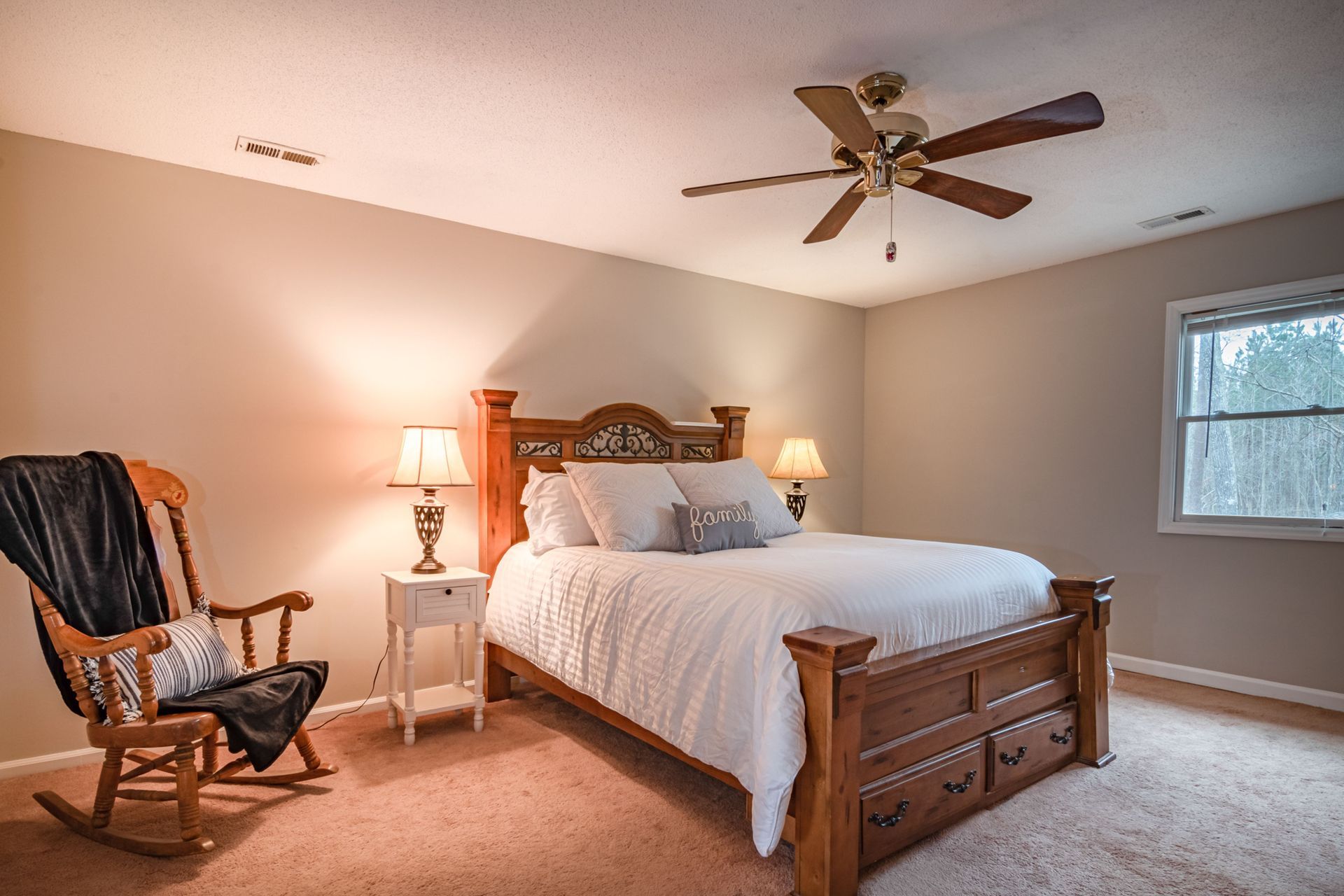
North Alabama summers run long and hot. For nearby Birmingham, NWS Birmingham's climate page puts typical midsummer afternoon highs in the low 90s, with July normally the hottest month, and a ceiling fan is an inexpensive way to make a bedroom or screened porch more comfortable. The US Department of Energy says a fan lets you set the thermostat about 4°F higher with no loss of comfort, as long as it turns counterclockwise in summer. Switch it to clockwise on a low speed in winter, and turn it off when you leave the room: the breeze makes you feel cooler, but it does nothing for an empty room.
The part that matters most is what the fan hangs from. A fan moves and wobbles in a way a light never does, so the electrical box above it has to be listed for fan support. Under the National Electrical Code, a box that carries a ceiling fan must be listed and marked as suitable for the purpose, a fan over 35 pounds needs a box marked for its weight, and no box can carry a fan over 70 pounds; heavier fans need support of their own. Many older ceilings were wired with a plain light box, Census survey figures date roughly 70% of the housing in the Gadsden City School District to before 1970, so we check the box before we hang anything. If it isn't fan-rated, we fit a braced fan box between the joists.
A room that has never had a fan usually needs a new cable run to the ceiling and a wall switch or separate fan and light controls, so that part gets priced on the free estimate.
Recessed Lighting
Recessed lights give a kitchen or low-ceilinged den even light without anything hanging down. In a finished ceiling, the layout, joist direction and the route for the cable all get worked out before the first hole is cut.
In a ceiling with an attic above, the fixture has to be the right type. The US Department of Energy's Building America program notes that code now requires recessed downlights in insulated ceilings to be rated for insulation contact (IC). It recommends airtight IC fixtures (marked ICAT) because an old leaky can draws far more air than a hole the same size, which means attic heat in July and lost warmth in January. Where insulation sits against the ceiling, we fit IC-rated housings or slim LED wafer lights, airtight (ICAT) where the fixture allows.
Light Fixtures, Pendants & Chandeliers
A like-for-like swap on a sound box is usually a simpler job. A heavy chandelier over a stairwell or dining table is another matter: the box and its mounting need to carry the weight, and an extra-tall ceiling may need scaffolding or a lift. Fixtures with integrated LEDs, pendants over an island and vanity lights over a mirror each have their own mounting and switching quirks, which are worth checking before you buy.
Older wiring sometimes shows up when a fixture comes down: cloth-covered cable, insulation made brittle by heat from old incandescent bulbs, or no ground wire at the box. When we find that, we show you and price the repair separately, and our electrical repair and wiring page explains the options. We do lighting work for shops and offices too, including older buildings in the Gadsden Downtown Historic District along Broad Street, where it pays to check the existing wiring first.
Outdoor, Porch & Security Lighting
Porch lights, floodlights over a driveway, path lights along a walk and motion-sensor lights by a side gate all sit out in the weather. A fixture under a covered porch needs at least a damp-location rating, and one exposed to rain needs a wet-location rating, so we match the fixture to where it hangs. Outdoor outlets that feed lighting or decorations belong on GFCI protection, which the Electrical Safety Foundation lists as a requirement for outdoor receptacles.
Alabama logged over 2.3 million lightning flashes in 2025, putting it 10th in the country for lightning density. Outdoor lights with sensors and LED drivers sit out in those storms, which is one reason to consider whole-home surge protection at the panel when the lights go in.
Security lighting works well on a motion sensor or a dusk-to-dawn photocell, so it isn't burning all night. We can put fixtures on timers too.
LED Upgrades, Dimmers & Switches
The Department of Energy says residential LEDs, especially ENERGY STAR rated ones, use at least 75% less energy than incandescent lighting and last up to 25 times longer. Swapping bulbs is easy. Where we come in is retrofitting old cans with LED trims, replacing fixtures that can't take LEDs well, and fitting the right controls.
Dimmers are where LED upgrades can go wrong. ENERGY STAR notes that not all certified bulbs are dimmable and that not every bulb works with every dimmer, so the bulb and dimmer need to be chosen as a pair, using the bulb maker's list of compatible dimmers. A dimmer that isn't matched to the new bulbs, such as an older dimmer made for incandescent bulbs, can cause buzzing, flicker and poor dimming. We fit LED-rated dimmers, timers and occupancy sensors to match the lights.
When a Light Problem Is a Wiring Problem
A switch plate that's hot to the touch, a smell of hot insulation near a light, and lights that dim or flicker are on the Electrical Safety Foundation's (ESFI) list of warning signs, and ESFI says to call a licensed electrician if you notice them. Switch off the breaker for that circuit if you can do it safely, and call 911 if you see smoke or flames.
Flicker that started the day new LEDs went onto a dimmer often points to the dimmer. Flicker in rooms you haven't touched is worth a call, and urgent problems are covered on our emergency electrician page.
In the city, electrical permits come from the City of Gadsden Building Department, which issues building, electrical, plumbing and mechanical permits for homes and businesses. Alabama has no statewide electrical code for houses (the state-adopted code covers only state buildings, schools and hotels), so rules can vary by town. If you live in Attalla, Rainbow City, Southside or Glencoe, check with your town. Ask about it on your free estimate.
Typical Lighting and Ceiling Fan Prices
Here's what published cost guides show for lighting jobs, as of October 2026. Most of them are national, since few guides break out Alabama. Treat them as a rough guide only, not as our rates: the free estimate we give you after seeing the ceiling is the price that counts.
Fans and lights, installed
- Ceiling fan, wiring already in place $100–$400
- Recessed light, each $100–$500
- Light fixture, installed $150–$1,000
- Standard like-for-like fixture swap $150–$350
What the electrician's time costs
- Hourly rate, most guides $50–$130/hr
- Service-call fee $100–$200+
A fan in a room with no ceiling wiring, a heavy chandelier or a long run of recessed lights costs more, and attic access and ceiling height change the labor. That's why the free estimate is the number to go by. The + on the service-call fee is there because some charge more.
Ranges taken from national cost guides, checked October 2026. Not a quote.
Lighting Work Across Etowah County
We hang fans and fit lighting in homes from Attalla on the west side of the county to Glencoe out on US 431, and in Rainbow City and Southside along the Coosa. Gadsden Electrician Pros is licensed and insured, and you can look up any Alabama electrician's license yourself on the state board's online license lookup before you hire. Panels, generators, repairs and our other services are all on the Gadsden Electrician Pros homepage.
Lighting and Ceiling Fan FAQs
Can a ceiling fan go where a light fixture is now?
Often, yes, and the existing wiring can usually be reused. The box has to be rated for a fan, though, and many light boxes aren't. We check it first and fit a fan-rated, braced box if it needs one.
Which way should a ceiling fan turn in summer?
Counterclockwise, looking up at it, so it pushes air down onto you. The Department of Energy suggests clockwise on a low speed in winter.
How much does it cost to install recessed lighting?
Published cost guides put recessed lighting at about $100 to $500 per light. The number of lights, attic access and whether the ceiling is insulated all affect the price, and your free estimate gives the real figure.
Why do my new LED lights flicker or buzz?
A common cause is that the dimmer wasn't designed for those bulbs, or the bulbs aren't dimmable. ENERGY STAR advises choosing the bulb and dimmer together. If the flicker isn't on a dimmer at all, or it affects lights across the room, have the wiring checked.
Do outdoor lights need special fixtures?
Yes. A covered porch needs a fixture rated for damp locations, and anywhere rain can reach needs one rated for wet locations. Outdoor receptacles also need GFCI protection.
Do I need a permit to install a ceiling fan or light?
It depends on the job and where you live. In the city, the Gadsden Building Department issues electrical permits, and neighboring towns may have their own rules. Ask about it on your free estimate.
Still have a question?
Got a lighting question that isn't covered here? Ring (256) 563-5225 or fill in the quote form, and we'll get you a free estimate.