
Whole House Surge Protector Installation in Gadsden, AL
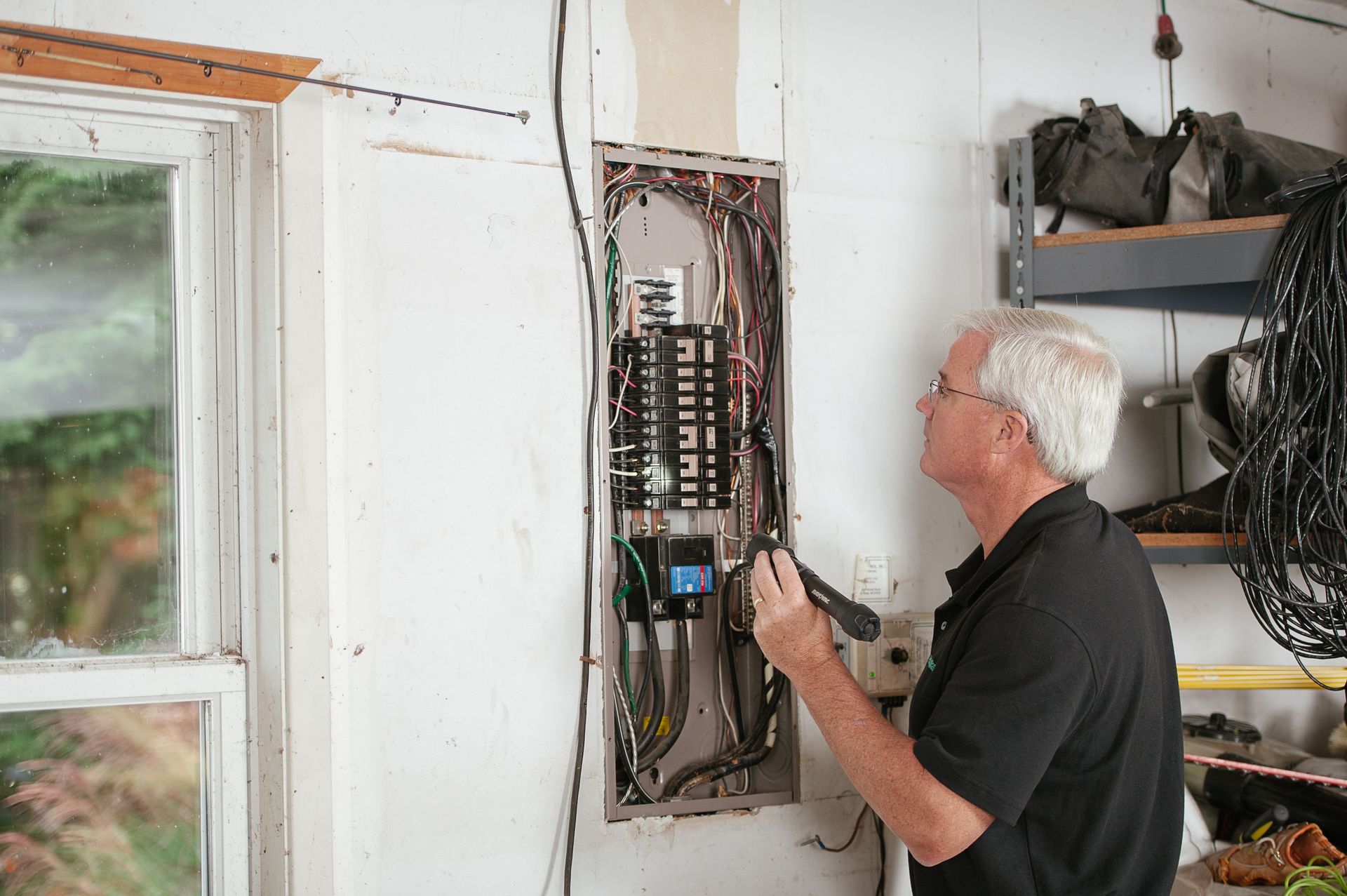
Our electricians at Gadsden Electrician Pros fit whole house surge protectors in homes across the city and out to Attalla, Rainbow City, Southside and Glencoe. The device mounts at your electrical panel or service entrance, where it can divert large surges coming in on the power line before they spread through the house's wiring. We check that the panel has space and that the grounding is sound before fitting it. Every estimate is free, a licensed and insured electrician fits the unit, and we tidy up before we go.

Contact Us
Surge Protection Work We Handle
- Panel-mounted surge protectors: Type 2 devices fitted in or beside your main breaker panel
- Service-entrance protection: Type 1 devices rated for the line side of the main breaker
- Code upgrades: a surge protective device added when a panel or service is replaced
- Worn-out units: replacing a surge protector whose status light has gone out
- Grounding and bonding checks: making sure the surge has a good path to earth
- Plug-in protection advice: which point-of-use protectors suit your TV, computer and internet gear
Where Power Surges Come From
Most surges start inside the house. The Electrical Safety Foundation (ESFI) puts the share that begins with equipment inside buildings at 60 to 80%, and names large appliances such as air conditioners switching on and off as a common cause. NIST calls these switching surges. So the air conditioner that keeps a Gadsden house cool through the summer is itself one of the sources.
Other surges come from outside, on the utility lines or from lightning. NWS Birmingham notes that summer rain around Birmingham falls almost entirely in scattered afternoon and early-evening thunderstorms. Insurance data shows what that costs: using its own and State Farm's data, the Insurance Information Institute (Triple-I) ranked Alabama 5th in the country for lightning-related homeowners claims in 2025, with 2,981 claims and $56.7 million paid out. That came in a year when AEM's lightning network counted fewer flashes than average across the state.
Alabama Power's thunderstorm preparation tips are to turn off air conditioners to prevent power surges and to unplug electrical devices you don't need. A whole house surge protector adds protection at the panel that doesn't depend on anyone being home to flip switches.
Type 1, Type 2 and Type 3 Surge Protectors
Surge protective devices (SPDs) are sorted into types by the UL 1449 standard, and the type tells you where a device can go.
- Type 1 units are permanently connected and listed for the line side of the service equipment's main breaker, between the utility transformer and your panel. They can also go on the load side, and ABB notes they don't need their own breaker or fuse.
- Type 2 units are permanently connected on the load side of the main breaker, which usually means in or beside the main panel.
- Type 3 devices are point-of-use protectors, the plug-in kind, installed at least 30 feet of wire away from the panel.
How a panel unit is fitted depends on the panel. Square D makes plug-in surge protectors for its QO and Homeline load centers that install like a standard breaker and take two pole spaces. Other units mount on the outside of the panel and are fed from a breaker sized to the maker's instructions; Siemens and Leviton recommend 20 amps for some of their models, and Square D suggests a 30-amp two-pole breaker for one of its external units. Siemens says to keep the leads as short and straight as possible because long leads hurt performance, and ABB says the shorter the lead, the better the device performs.
A lot of local housing is older. For the Gadsden City School District's census area, seven in ten homes date from before 1970. Older panels can be full, so part of the estimate is finding two free spaces or a sensible place to mount the device. If the panel itself is past its best, our electrical panel upgrades page explains the options.
What the Electrical Code Requires
Section 230.67 of the 2020 National Electrical Code says every service supplying a dwelling unit must have a surge protective device, either built into the service equipment or right next to it (an exception lets it sit at the next level of distribution equipment downstream instead), and that it must be Type 1 or Type 2. The rule also covers service equipment that is being replaced, so a panel change brings it in. The 2023 edition kept that and added a minimum nominal discharge current rating of 10 kA.
Which edition applies depends on where you live. The International Association of Electrical Inspectors notes that Alabama has no statewide electrical standard: the code the state adopted applies only to state buildings, schools and hotels.
Inside Gadsden city limits, electrical permits are issued by the City of Gadsden Building Department. Alabama Power's rules give the customer, not the utility, sole responsibility for getting the inspecting authority's approval. If you live in Southside or Glencoe, which run over the county line into Calhoun County, the right office can depend on which side of the line you're on. We'll go over what your address needs when we come out for the estimate.
Lightning and Your Home
The National Weather Service explains that lightning reaching a house can travel through its electrical, phone, plumbing and TV reception systems, coming in along any wire or pipe that runs outside. It also says lightning can create surges that damage electronics some distance from the strike. The CDC's lightning advice includes fitting whole-house surge protectors to protect your appliances.
There is a limit, and it's worth knowing before you buy. The NWS says typical surge protectors will not protect equipment from a lightning strike, and NIST makes the point that even the best surge protector can be useless if the grounding isn't right. A whole house unit diverts large surges arriving on the power line; it can't promise to stop a direct hit. That's why we check the grounding and bonding as part of the job.
Storms here take the power down as well. During the Aug. 3, 2023 storm, Alabama Power reported more than 10,800 customers without power in Etowah County, about 5,700 of them in Gadsden.
Don't unplug equipment once a thunderstorm has started: the NWS warns there's a risk you could be struck. Unplug the devices you don't need before the storm arrives, as Alabama Power's storm tips advise. If the power goes out, the Red Cross advises unplugging appliances and electronics to avoid damage from surges, and calling an electrician to check any tripped breakers before you turn them back on.
Panel Protection Plus Plug-In Protectors
A device at the panel and a protector at the outlet do different jobs, and makers such as Eaton and Leviton recommend both. Eaton advises two stages, one at the service entrance and one at the point of use, and Leviton says a surge breaker in the main panel alone isn't enough to guarantee protection if lightning strikes the home or the area around it. NIST describes the service-entrance protector's job as diverting large surges on the power line before they enter the house, and suggests a surge protector for each sensitive appliance as well.
Cable and phone lines can carry surges too. Snohomish County PUD notes they can come in through the power, phone or cable TV connections, so plug-in protectors with coax and phone jacks help protect a TV, phone or computer. When you buy plug-in units, check the label: a strip without a UL 1449 listing may be an outlet strip on an extension cord rather than a surge protector. Portland General Electric advises not choosing on the joule rating alone, because the testing methods behind it aren't standardized.
How Long a Surge Protector Lasts
Many surge protectors rely on metal oxide varistors (MOVs). Schneider Electric says repeated surges degrade MOVs over time, so a unit that has handled several surges can be weaker even if it looks fine; some last a few years, others work for decades. Many surge protectors have an LED that shows whether they're working, and some, such as Siemens' FirstSurge units, signal when the unit is worn out. On Leviton's 51120, for example, a green light going out while the power is on means a surge exceeded the device's rating and it should be replaced.
The ratings on the box tell you what a unit can take. The voltage protection rating (VPR) is the UL 1449 measure of how much voltage the device lets through. The nominal discharge current (In) is the surge current it handled repeatedly in UL testing, and it's the figure the 2023 code sets at 10 kA or more. Some makers, such as Eaton, also list a maximum surge current per phase in kA. We'll talk through these when you choose a unit.
Surge Coverage Plans and Insurance
A repair plan isn't a surge protector. Alabama Power customers may have seen optional "Electrical Surge Coverage" plans offered through HomeServe, a separate company, which help pay for repairs to major appliances after a power surge. They pay toward fixing damage after it happens. A surge protector at the panel works to limit surges before they reach those appliances.
On the insurance side, Triple-I says some homeowners policies cover power surges that are the direct result of a lightning strike. Check your own policy, and if you're on a co-op such as Cherokee Electric or Marshall-DeKalb Electric, which serve parts of Etowah County, ask them what they offer.
Typical Whole House Surge Protector Prices
We took these ranges from national cost guides in October 2026. Read them as a ballpark rather than our price: once we've looked at your panel and grounding, the free estimate sets the real figure.
At the panel
- Whole house surge protector, installed $200–$800
- The device alone, by type and brand $60–$700
- Electrician's labor, straightforward job $140–$300
- Grounding repair, if needed $100–$700
At the outlet
- Plug-in surge protector strip, each $10–$60
What moves the price. A panel-mounted unit in a panel with free spaces sits at the low end. A Type 1 unit at the service entrance pushes the price up, and so does a crowded panel or grounding that needs repair.
Ballpark surge protection costs drawn from published national guides, October 2026. Not a quote.
Surge Protector FAQs
How much does a whole house surge protector cost?
Cost guides put a whole house surge protector, installed, at about $200 to $800, and the device alone at about $60 to $700. A Type 1 unit, or extra panel or grounding work, moves a job toward the top. Your own price comes with the free estimate.
Is a whole house surge protector required by code?
The 2020 and 2023 editions of the National Electrical Code, where a town has adopted them, call for a Type 1 or Type 2 surge protective device at the service to a home (or, under an exception, at the next level of distribution equipment), and the rule applies when service equipment is replaced. Alabama has no statewide electrical standard, so whether it applies depends on the code enforced where you live.
Will it protect my house from lightning?
It helps with the surges lightning sends along the power lines, but the National Weather Service says typical surge protectors won't protect equipment from a lightning strike itself. Good grounding and plug-in protectors on sensitive electronics add to what the panel unit does.
Do I still need plug-in surge protectors?
Yes, for sensitive electronics. Eaton and Leviton both recommend protection at the panel and at the point of use. Choose plug-in units listed to UL 1449, with coax and phone jacks for TVs and internet equipment.
How long does a whole house surge protector last?
There's no fixed life. Repeated surges wear the internal parts over time, so the more surges a unit takes, the more it wears. Many have a status light, but what the lights mean varies between makers, so check the instructions; when it shows the protection is gone, the unit needs replacing.
Can it go in my existing panel?
Often, yes, if there are two free breaker spaces for a plug-in unit or room to mount one beside the panel. If the panel is full or failing, a panel upgrade may come first.
Does Alabama Power offer surge protection?
We couldn't find an Alabama Power program that installs a surge device. It offers optional surge repair coverage through HomeServe, which helps pay for appliance repairs after a surge rather than preventing one.
Still have a question?
Want to know what protecting your home would take? Ring (256) 563-5225, or put the question on the quote form, and we'll arrange a free estimate.